Ash Knights
The Ash Knights were not founded to wage war. Their first oath was sworn in a burned settlement: name the dead, clean the well, and stop those hunting the survivors.
Ash names their work, not their armour. After fire, revolt, plague, magical disaster, or massacre, a knight takes responsibility for what remains. They measure victory not in captured ground, but in a working well, a safe road, buried dead, and a school able to open again.
The Ash Knights are one of many independent Ash orders in the Eshrenic world; they neither govern nor outrank the others. Their home is Ash Threshold, an island off the continental coasts. Eshrenic families send children there to learn; repairers, scribes, healers, and road workers live there; the Ash Shadow finds refuge under island law. The island was built not as a warrior monastery but as a country for learning how to live after a wound.
Five vows
- The living first: refuge, water, and wounded people come before revenge.
- Keep the name: no dead or missing person may become merely a number.
- The open wound: harm cannot be concealed; a knight witnesses even against a friend.
- Measured force: violence used for protection must explain its target and its repair afterward.
- Debt of ash: after conflict, the order remains at least one season to repair the place.
The oath asks for neither noble birth nor a particular people. An aspirant may be a fighter, carpenter, healer, scribe, former soldier, or person displaced by war. Knighthood requires martial training; citizenship of Ash Threshold does not. The Ash Knights protect that distinction: every child is raised as a citizen able to weigh word and work, not as a recruit waiting to be made.
Ash Threshold and open education
Many Eshrenic families prefer Ash Threshold over smaller local Ash hearths for their children’s education. That is not because the island is more severe. Threshold schools teach faith through work before recitation: clean-water inspection, first aid, reading agreements, recording the names of the dead, coastal farming, magical-wound safety, and collective decision-making. Students do not learn one another’s peoples as exotic exceptions; island life already rests on the common labour of families with human, elven, dwarven, goblinoid, sea-people, and countless other roots.
There are also lessons in sword, shield, rescue rope, and magical safety. Their first rule is that taking up a weapon does not make someone entitled to another life. Aspirants to knighthood later enter a separate path of testing; what is compulsory for everyone is learning aid and witness.
Dragon gate and visible watch
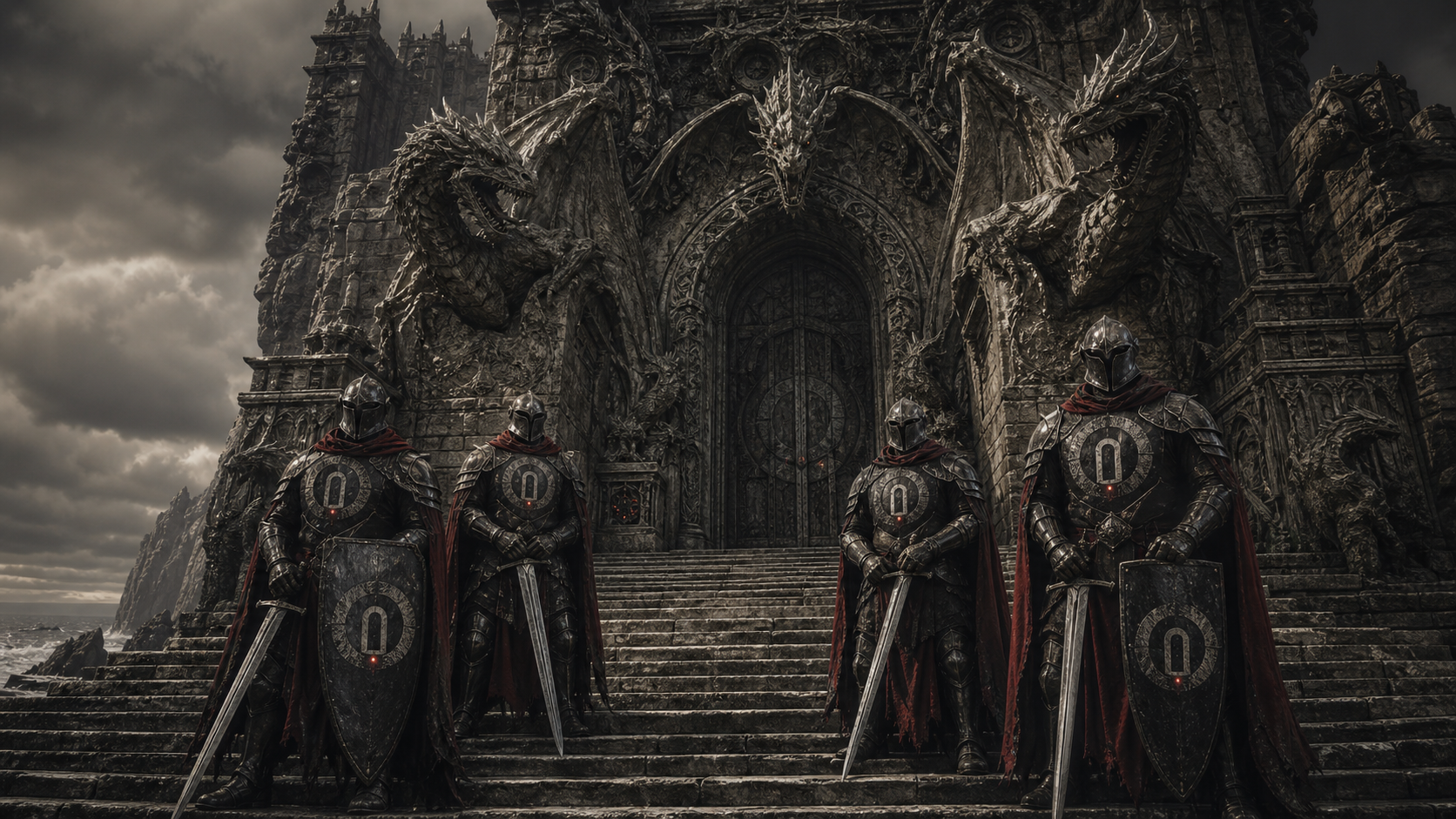
Ash Threshold’s main gate is first recognised from the shore by its dragon stonework. Those dragons are neither sacred beings nor marks of conquest. The family device of the order’s master, whose surname carries dragon lineage, was made into a memory in stone by the island’s founding masons: vast heads watch the harbour from above, broken wings frame the passage, and their mouths face the sea rather than the people entering. The message is not a challenge to an enemy, but that the island’s burden is carried where everyone can see it.
Knights stand watch beside one another at the gate, faces closed and blades lowered. Their dark steel armour and shield faces carry the Open Threshold Seal: a broken ash ring open at its crown, a stone door within it, and one ember point at its foot. Their red mantles are not dynastic colour; they are a visible promise not to hide what remains after a place burns.
The order’s branches
Ash Knights secure the physical conditions for roads, refuge, quarantine, and testimony. They close magical rifts, contain poisoned ground, record war crimes, and evacuate civilians when necessary.
Houses of Repair bring together healers, water workers, teachers, mediators, and builders. They may arrive before or after the knights; their purpose is to stop the knights from trying to solve every problem with armour.
Name Ledgers record missing people, debts, mass graves, forced displacement, and promises of repair. They are not court judgments, but a counter-memory no crown can erase.
Ash Shadow is not part of the Ash Knights, but a separate Eshrenic path that conflicts with them. Its members may live, heal, and raise families on Ash Threshold, but cannot teach in child schools, vote in the Open Witness Assembly, or turn the island into a base for covert action. The boundary is not a triumphal story. Knights accept that expelling the Shadow would not remove their responsibility; the Shadow calls the limits cowardice.
Taking the oath
An aspirant’s first test is not a duel. They choose an open wound—a poisoned well, unburied battlefield, abducted-child network, burned bridge, or unjust levy—and name before those harmed both what they can do and what they cannot. Failure does not break an oath. Lying, abandoning the debt, or seeking renown instead of repair does.
Island-born aspirants receive no privilege. A young person raised on Ash Threshold takes their first duty on another shore, away from family oversight. The island is thus kept from becoming a closed house that blesses its own children.
War, corruption, and account
Ash Knights carry weapons, but distrust becoming an army’s vanguard. Kings praise their independence until they witness against royal soldiers. The order rejects Purifier doctrine openly: treating a people, patient, or mage as born corruption does not close a wound; it spreads one into new bodies.
Their bond with the Ash Shadow is tense. Knights admit that some Shadow targets are real harm-doers, but hold that hidden killing makes the debt of account heavier. The Shadow replies that when court, army, and shrine all serve the cruel, open procedure punishes only those left exposed. Living on the same island does not resolve that tension; it merely makes everyone see the wound the other leaves behind.